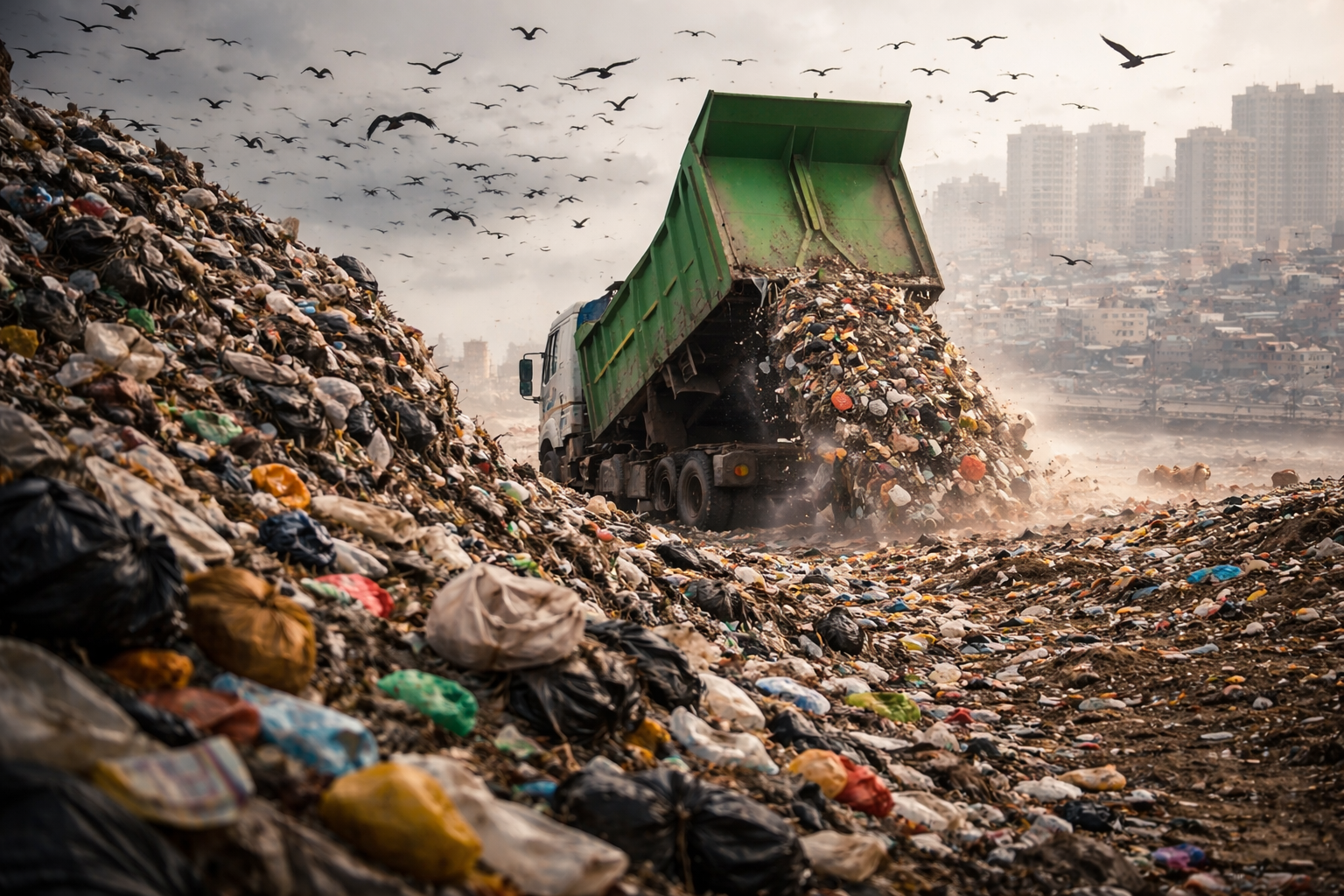
India’s cities produce waste at a pace that outruns recovery infrastructure. Landfills are not a strategy; they are a default—absorbing plastics, organics, and recyclables that should never have shared the same tip face.
The challenge
When a truck lifts its bed, the load is rarely a single stream. PET sits next to wet organics. Film plastic wraps around cardboard. Metals hide under soiled packaging. Downstream buyers reject contaminated bales. Upstream, municipalities pay to move volume that will never return as revenue.
The visual is familiar: a green tipper against a horizon of bags, scavenger birds, and brown air. What it hides is economic leakage. Every mixed ton that lands is a ton that skipped characterization, purity grading, and buyer matching.
Landfills grow when recovery is treated as optional. Smart Sortation™ makes recovery the line of least resistance.
The approach
gnufox designs facility-scale Smart Sortation™ systems—beginning in Odisha—that intercept material before it becomes permanent geography. Vision AI identifies polymer type and form at belt speed. Air jets and robotics divert into commodity-grade streams. Operator dashboards sync purity with industrial offtake.
Paired with scheduled collection through Wasty™ user and partner apps, the chain shortens: curb → facility → buyer, instead of curb → dump → smoke.
What changes
Municipalities reclaim land pressure and air quality. Operators capture higher-purity tons. Workers move from informal scavenging on the tip face to structured roles inside the plant. The mountain still exists—but its growth rate becomes a metric you can manage, not a fate you accept.
This is the case for treating MSW as an industrial feedstock problem, not only a sanitation cost. From Bhubaneswar outward, that is the work gnufox was built to do.